This morning we left the dead sea area and went just down the road to to Masada. This is a large plateau mountain where the first King Herod built his Armageddon fortress. It was to be his "safe house" if he ever needed it. No one really knows if he ever actually used it. But his palace was incredible complete with huge bath and sauna. The technology of the ancient world was amazing. His sauna for instance would have heat piped in under the floor and up the walls. Then the water would be thrown on the walls and would evaporate instantly. It would then condescend on the smooth ceiling, and run down the hot walls and then evaporate again and continue the cycle. After Herod died, in the mid 60's AD, some Jewish rebels took over the small regiment stationed there. A few years later, when the Jews rebelled against the Romans and the Romans were out to annihilate the Jews, a group of about 900 fled to Masada for the final holdout. What made Masada such a great fortress and stronghold was its steep cliffs and rugged terrain (as you can see from the pics below). There was only one way up and one way down, the Snake Trail. It was very rugged and was a single lane, winding trail up. The Romans marched on Galma, marched on Jerusalem and the temple and then came to Masada, the last of the Jewish Rebellion. Here, the Romans obviously had trouble climbing and attacking the Jews on top of Masada. Meanwhile, because of the strategic defense and using the large amounts of food and resources that was stored at Masada for King Herod, the Jews had plenty to live off of and hold out. They had ways to gather water on top of the mountain. At times they had so much water they would use the extra to taunt the Roman army below. They would stand on top of the walls of Masada and pour water on their heads, while the Romans seriously lacked water, and would have to march for miles to En Gedi for fresh water in the desert. During excavations of the huge food store houses on Masada a few years ago, they found grains of wheat from the period. They took that wheat to their top scientific and research community in Israel and have actually germinated and grown that wheat from the 1st century. They are now studying and learning about wheat and food mutation and growth over the last 2,000 years. Incredible!!!
The Jews held out on Masada for three years, until the Roman army decided to build a huge land siege bridge up to the walls of Masada. They finally reached the wall, broke a part of it down and instead of rushing into the fortress, they went back down the ramp and waited til the next morning to lay siege to it. That night however, the Jewish leader gathered everyone together and gave a moving speech about how it would be better to die a free Jewish people, than to die or be tortured and raped at the hands of the Romans and become their slaves. All 900+ Jews agreed to mass suicide. Ten men killed everyone, and then those men drew lots to see who would kill who, and who would be the last and fall on his own sword. Archeologist have found those pot shards they used to cast lots.
The next morning, as the Romans charged up the ramp, they found everyone dead. Next to each body laid a bowl of food and water. This was to show the Romans that the Jews were not desperate for food or water and could have lived on top of Masada indefinitely and they thought death better than falling into the hands of the Romans. There were three small orphan children and two very old ladies that survived. No one thought the three orphan children old enough to choose death and since they had no parents to decide for them, they were spared, along with the very elderly ladies to looked after the children. The Romans saw the bodies and left Masada with a bitter victory.
This story is very much like the Alamo for us. This was the last time, until 1949 that Israel was seen as a state.
We then traveled on to the oasis En Gedi. This is where David could have killed King Saul but instead cut a piece from his garment and taunted him. It was a small but beautiful oasis in the desert. It used to be a larger with more water flow but an earthquake changed the landscape and the flow of the water.
We then went over a short distance to Qumran. This is the site where the shepherd boy found the clay pots that held what we now know as the Dead Sea Scrolls. At Qumran they have uncovered a large Essen village or Dead Sea Jews village. The authors of the dead sea scrolls most likely lived and wrote the scrolls here. We even saw one of the large rooms that is believed to be the very room or rooms like it that they wrote the dead sea scrolls in. In the caves of Qumran, they found parts of every book of the old testament excluding Nehemiah and Esther. Many of the scrolls dated back to 300 BCE. The most incredible find was the book of Isaiah. It was found complete. When compared to the modern day version of Isaiah, it was very nearly word for word. As the scribe would copy the scroll, he would have the word read to him, he would then repeat it out loud as he wrote it down, so that he would not make a mistake or misunderstand.
We left Qumran and traveled to Jerusalem. We went up on top of the Mt. of Olives and had a Sunday worship service overlooking the Temple Mt. We could begin to see and picture it all. It was on this mountain top, Mt. Moriah that Abraham bound his only son and was ready to sacrifice him to the Lord. It was here that David set up his capitol city that was about 10-12 acres. Now, today, the city of Jerusalem is over 60 sq km and is home to 700,000 people. We went from the Dead Sea that morning at 1,228 ft below sea level, traveled a total distance of 82 miles and went up to a maximum elevation of 2,740 ft above sea level.
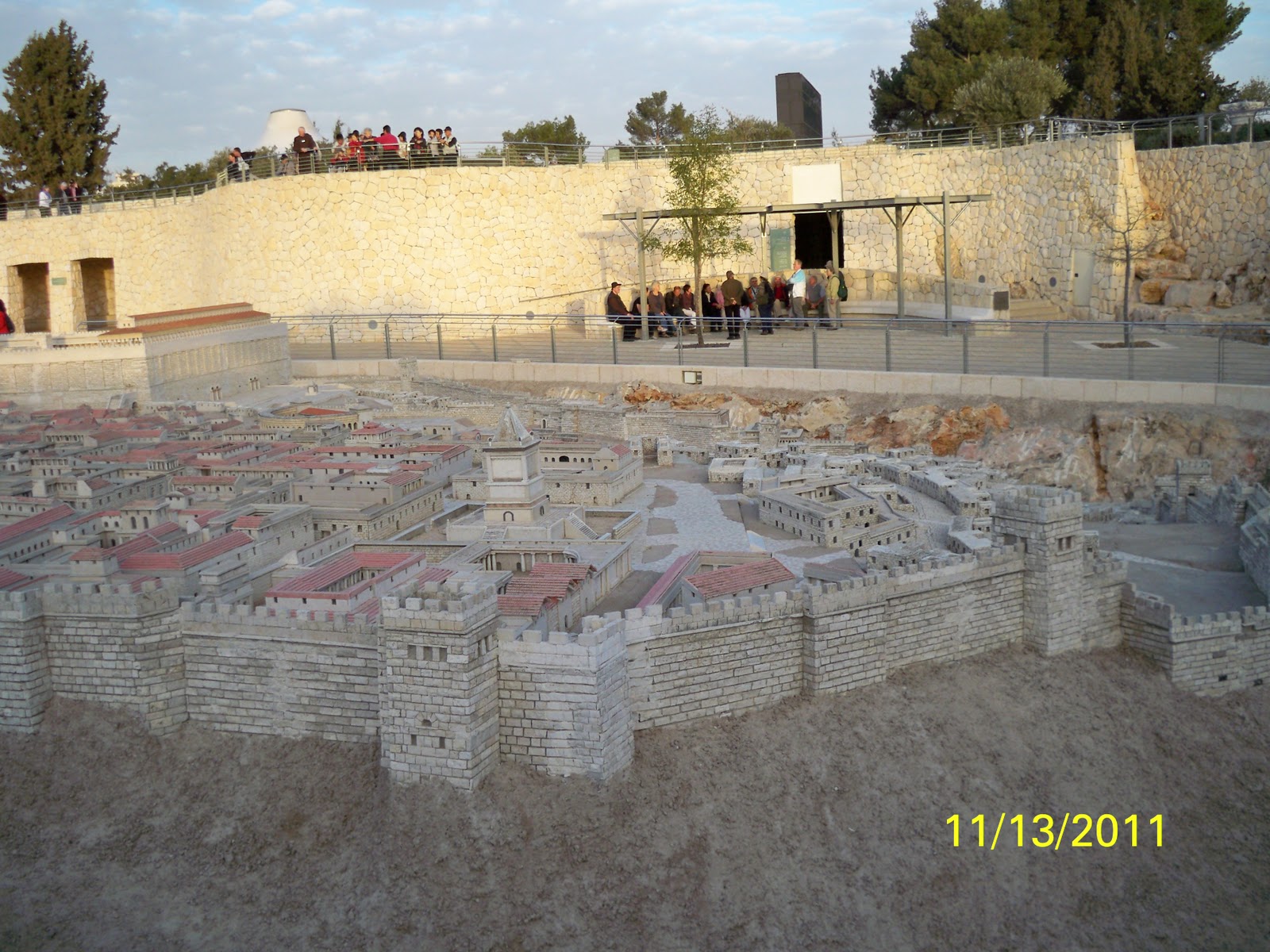
We went down from the Mt of Olives and visited the government buildings of Israel (parliament and congress type buildings). While there we saw the actual Dead Sea Scrolls. We also saw a scale model of ancient Jerusalem from 66 AD before the Romans destroyed it. This model was 1/50 scale. The third wall or outside wall was not there in the time of Jesus. Much of the the rest of it was. Including of course the temple. It was amazing to see and think about the temple being that large. It would have dominated the skyline and the focus of the city. Obviously the point. Just off to the side of the temple was Pontius Pilot fortress or guard house where he could keep an eye on the Jews. If a revolt were to take place, it would begin at or near the temple. Also on the north side of the city is Jaffa Gate. It would most likely would have been this gate that Jesus would have been led out of the city to be executed. Down south of the temple mt. is the old city of David. It paled in comparison to the large city but was cool to see how it was set up. At the far south corner of the city of Jerusalem is where three valleys connect. From left to right they were the Hinnom Valley, the Tyropoeon Valley, and the Kidron Valley. These three valley intersect or come together at the far south tip of the city. When looking at them from above, they form the Hebrew letter "Shin". This letter stands for one of God's most holy and mystical names, "El Shaddai". It is then interesting to read for instance 1 Kings 8:29 where it says, "May your eyes be open toward this temple night and day, this place of
which you said, ‘
My Name shall be there,’ so that you will hear the
prayer your servant prays toward this place."
 |
| Mesada |
 |
| Ruins of Mesada |
 |
| Land Siege Bridge Romans Build to climb Masada |
 |
| Synagogue in Masada |
 |
| A Scribe in the Synagogue on Masada copying the Torah |
 |
| Paint on the walls showing the elegance of Herod's bath house on Masada |
 |
| looking down on the snake trail |
 |
| En Gedi |
 |
| En Gedi |
 |
| Ruins at Qumran |
 |
| large rectangle room is where the scrolls would have been written |
 |
| Jerusalem Model |
 |
| Pilot's guard tower |
 |
| Jaffa Gate |
 |
| City of David |
 |
| Where the three valleys meet to form Hebrew word "Shin" |
 |
| Temple Mount |